Study 01 · Rendering
Event Horizon
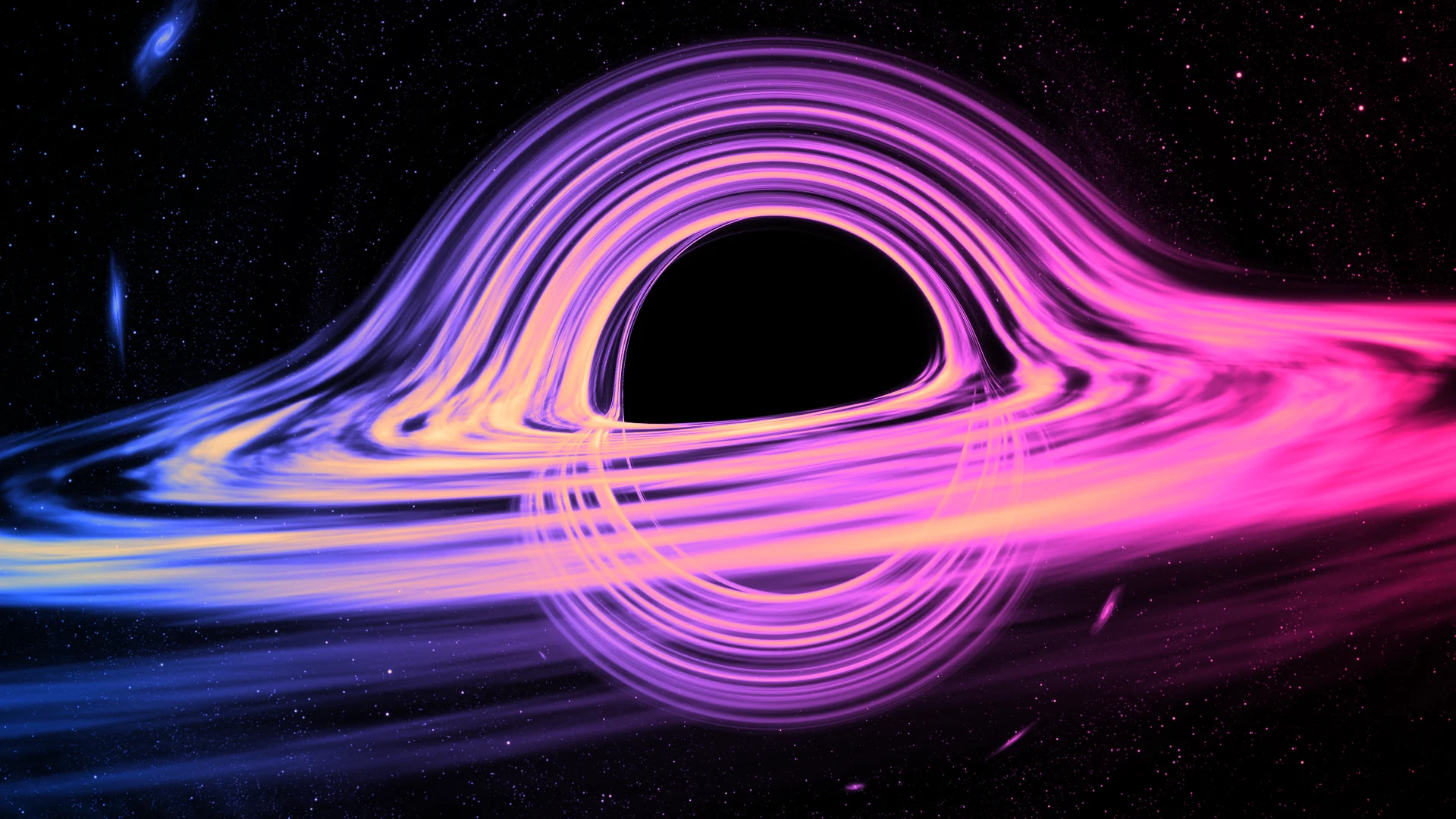
A spinning black hole, rendered by tracing light rays for every pixel on the GPU. The disk's turbulence comes from a published simulation.
- Film · finished
- Live view · not public yet

The rest frame of the film, graded for this site. In full motion the 8 s hold loop plays over it while it is on screen.
01
What it is
A renderer for a spinning black hole that follows light backwards from the camera, one ray per pixel.
Event Horizon is the lab's own renderer for a rotating (Kerr) black hole. For every pixel it follows a ray of light back from the camera through the curved spacetime until the ray reaches the disk, falls into the hole or escapes to the sky. The tracer is written in WGSL and runs on the GPU through vercel-labs/vgpu.
The disk is textured with turbulence taken from a published simulation in The Well.1 The sky is a star catalogue with the Milky Way and real constellation figures. The output is the film on the home page. It exists as a film and as stills; this page never runs the renderer.
- Film, 1740 frames at 120 fps
- 14.5s
- Spin a, ISCO at 2.32 M
- 0.9
- Largest error against Bardeen's shadow, a = 0.9
- 2.6e-4
- Simulation data read for the disk, by range requests
- 5.6MB
- 1Camera33 M from the hole, a little above the disk plane.
- 2Hits the diskThe ray bends round the hole and reads the disk texture.
- 3EscapesIt passes by and reads the sky.
- 4Falls inThe hole captures it, so the pixel is black.
02
From data to image
The turbulence in the disk is read from a published 3D simulation, not drawn.
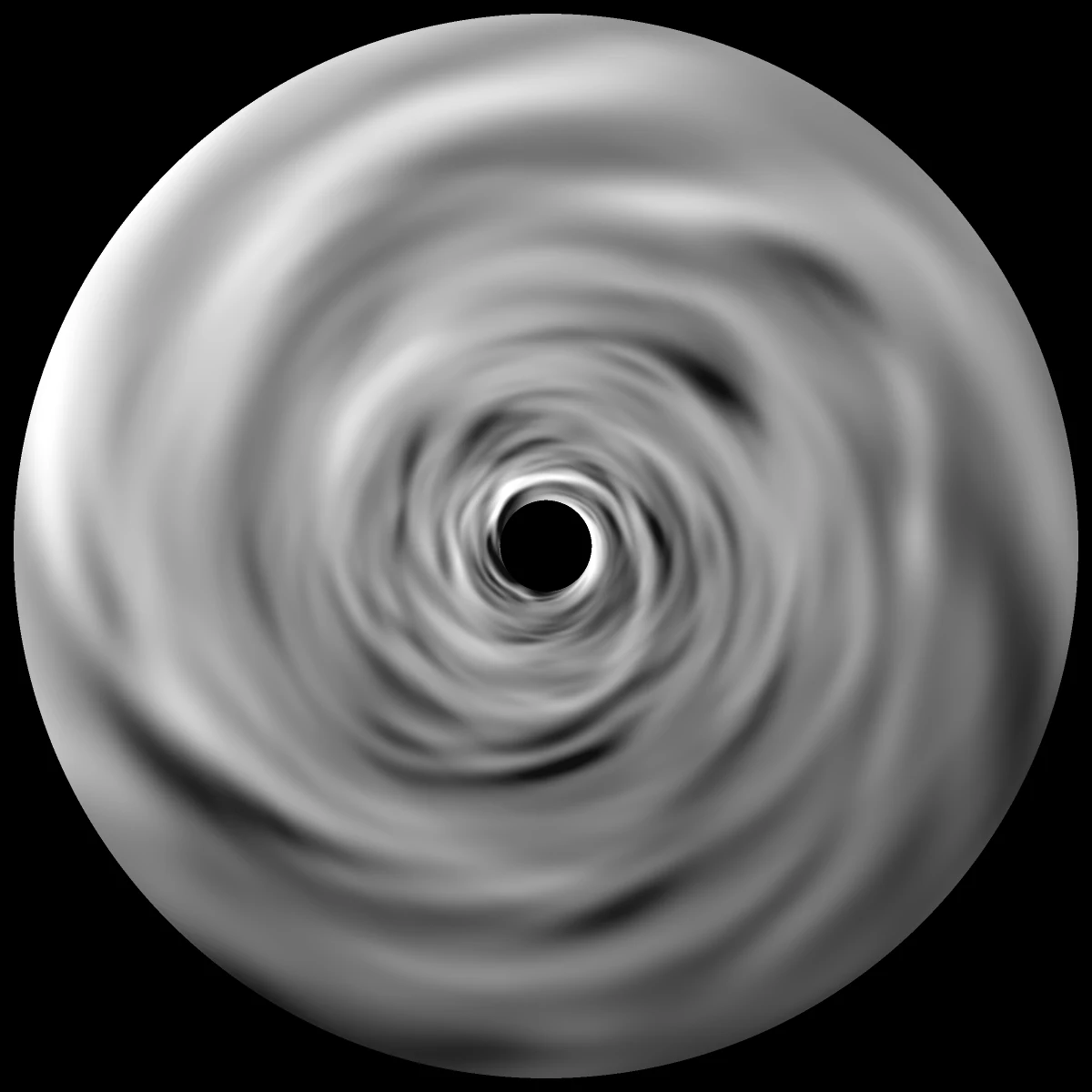
- SimulateA 3D general-relativistic neutrino-radiation MHD run of the disk left by a neutron-star merger. Grid 192 × 128 × 66, 181 snapshots 50 M apart.
- Take the midplaneAverage the four cells around the equator, then subtract each radius's mean of ln ρ so only the turbulence remains.
- Pack an atlasSnapshots 70 to 93 (t = 4000 to 5150 M) become 256 × 256 tiles. Reading them takes about 5.6 MB of range requests.
- Map to the holeRadius maps one to one in M from 2 M onto the renderer's disk. The renderer's hole spins at a = 0.9, the simulation's at a = 0.69.
- Dataset
- post_neutron_star_merger, scenario 3 (torus_gw170817), in The Well. CC BY 4.0.
- Simulation
- nubhlight, 3D GRMHD with neutrino radiation. Black hole of 2.58 solar masses, spin a = 0.69, innermost stable orbit at 3.44 M.
- Grid and time
- 192 × 128 × 66 cells in ln r × θ × φ, r from 1.4 to 1000 M. 181 snapshots every 50 M, from t = 500 M to 9500 M.
- Used here
- Density at steps 70 to 93, t = 4000 to 5150 M. The first of them, t = 4000 M, is the slice above.
Giving the disk depth
The renderer also has an optional volume treatment for nearly edge-on views. With vol = 0.006, the disk has a Gaussian scale height of 0.6% of the local radius. The shader blends five samples along a grazing ray. A rotation of vol_turn = 0.12 radians per layer keeps neighbouring patterns aligned, so dim gas can show between the bands while the lensed rings stay distinct. This is a rendering choice based on the midplane texture.
03
Checks and limits
The results below come from three numerical checks recorded in the lab’s renderer notes.8
- Against Bardeen's shadowThe lab checked the relative error in the shadow radius at 48 angles around the image. At spin a = 0.9, inclination 84° and camera distance 4000 M, the largest recorded error was 2.6e-4, down from 7.8e-3 after capping the step size near the horizon. The median error was 2.5e-4, consistent with the finite camera distance.
- WGSL against a float64 oracleThe float32 tracer on the GPU is compared ray by ray with a float64 tracer in Python at the film's framing. They agree to within what half-float storage of the lens map allows.
- Conserved quantities and step sizeAlong sampled rays the integrator keeps the null condition at zero and Carter's constant conserved. Disk crossings are interpolated with a cubic Hermite curve; the median error against a trace 32 times finer is 7e-8 in r.
H = ½ g^μν p_μ p_ν = 0         null geodesic in the Kerr metric
state = (r, θ, p_r, p_θ, φ)    Boyer–Lindquist coordinates, E = M = 1
dλ = 0.05 r                    RK4 step, finer near poles and horizon
Stated limits
- Resolution
- Between 2 and 40 M the run has 66 cells around the ring and 88 in ln r. The texture is a smooth upsampling of them, so nothing finer than about 2 cells (11° in φ, 7% in r) is real data.
- What transfers
- Only the shape of the turbulence: trailing spiral filaments with a pitch of 10 to 12 degrees, and clumps. The simulated disk is hot, dense and neutrino-cooled; its densities and temperatures are not used.
- Filaments
- The thin spiral filaments are procedural. They add sub-cell detail on top of the data.
- Different holes
- The simulation has a = 0.69 and its innermost stable orbit at 3.44 M. The renderer uses a = 0.9 and 2.32 M.
- Sky
- Real stars and constellation figures, rotated for composition. The few galaxies are procedural illustrations.
04
Colour
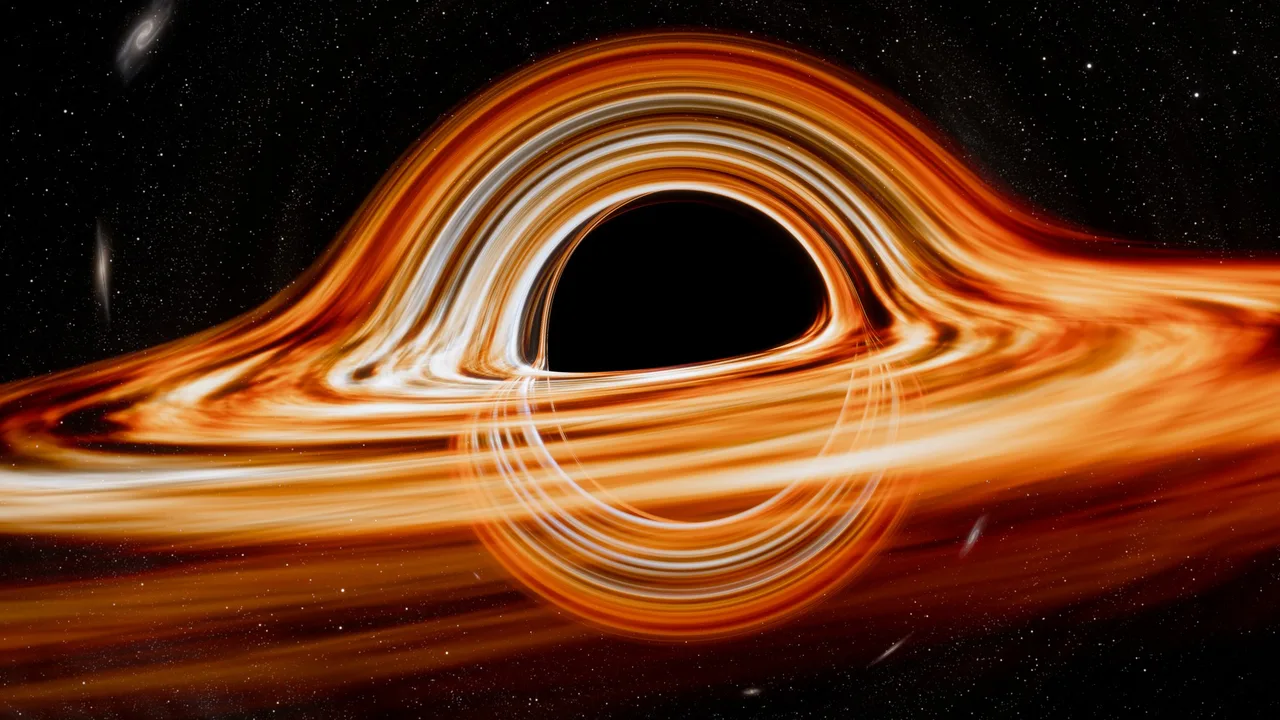
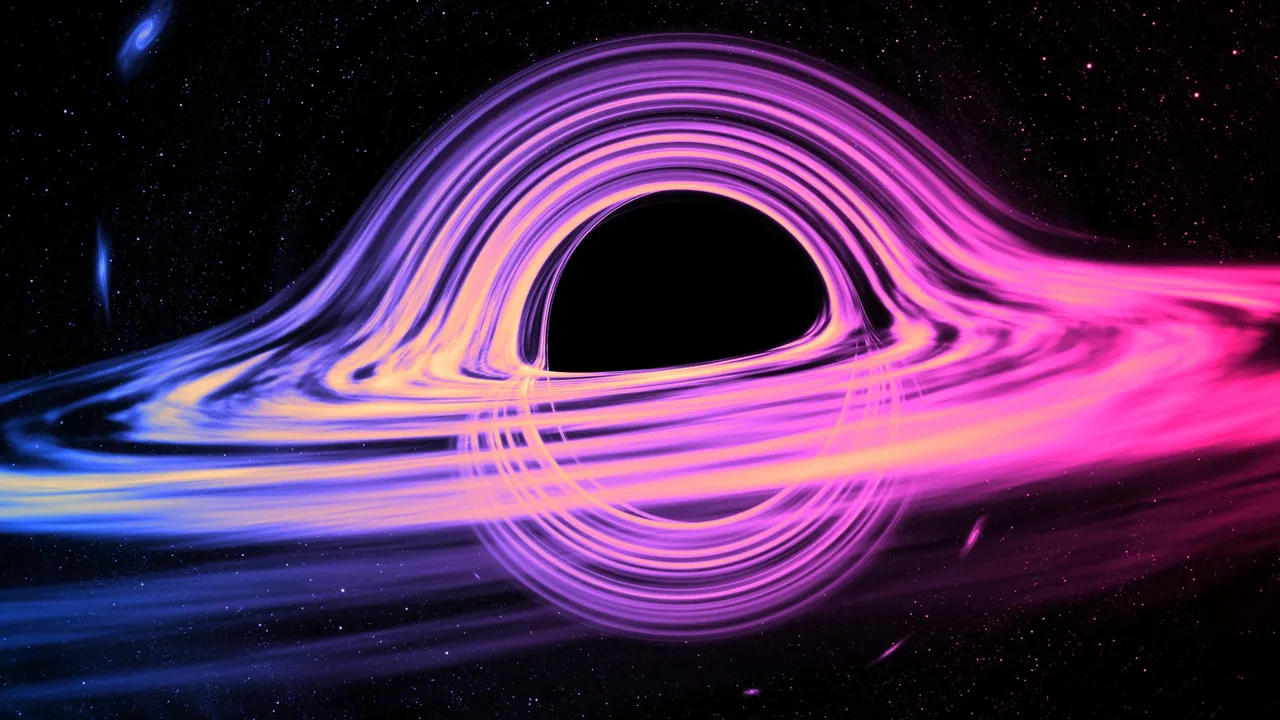
The film is graded for this site. It is not physical colour.
The renderer's own output is amber. For this site the frames are regraded offline, pixel by pixel from the render's brightness. The approaching side of the disk goes blue, the receding side magenta, a violet radial sits behind the disk, and the brightest parts go to orange and warm white. At rest, the grade matches the approved still to within 0.7% RMS.
- Approaching
#2F6BFF - Receding
#FF2A8A - Radial
#7A3CFF - Highlights
#FF9A3C - Peaks
#FFF4DC
05
Live view
Nothing on this page runs a simulation.
The live view is not public yet
A WebGPU build of the renderer exists as a lab tool. It is not published, and this page does not start it.
Planned for when it is: opt-in only, with flow off at the start, paused when offscreen or hidden, 30 fps while flowing, and a still from the same renderer until the first frame. A browser without WebGPU will be told so and keep the still.
Technical details
One WGSL pipeline serves the browser build and the offline stills and film: the tracer in trace.wgsl and the shader in shade.wgsl, both checked with vgpu check --require-validation. The film and the stills are rendered offline in Node through vgpu 0.5.0. The float64 oracle is blackhole.py.
06
Film facts
One film, rendered once, in landscape and portrait.
- Render
- Rendered on 28 Sep 2026. 14.5 s, 1740 frames at 120 fps on the render timeline. The site's files carry every second frame: 870 frames at 60 fps.
- Camera
- It arrives along one distance curve, comes to rest 33 M from the hole at 4.5 s, and from 6.5 s only the disk flows. The hold loops from there.
- Sky
- About 965,000 stars to magnitude V ≈ 11, the Gaia Milky Way and the constellation figures, all drawn through the black hole's lens map.
- Stills
- The rest frame at 1920 × 1080 and at 3840 × 2160, which is the renderer's own 2x frame, both graded the same way. Portrait: 1080 × 1920 and 2160 × 3840.
- Colour tags
- The H.264 files are tagged primaries BT.709, transfer sRGB, matrix SMPTE 170M, limited range. The VP9 files carry the same primaries and transfer. A player that reads the tags decodes the film to match the stills.
| Rendition | H.264 | VP9 |
|---|---|---|
| 1080p, 60 fps, 14.5 s | 12.8 MB | 7.1 MB |
| Portrait 1080 × 1920, 60 fps, 14.5 s | 10.6 MB | 5.1 MB |
| Hold loop, 720p, 30 fps, 8 s | 1.36 MB | 1.24 MB |
| Portrait hold loop, 720 × 1280, 30 fps, 8 s | 1.12 MB | 0.91 MB |
07
Sources
- R. Ohana et al., "The Well: a Large-Scale Collection of Diverse Physics Simulations for Machine Learning", NeurIPS 2024 Datasets and Benchmarks, arXiv:2412.00568. The collection is by Polymathic AI. arxiv.org/abs/2412.00568
- The dataset post_neutron_star_merger (scenario 3), released under CC BY 4.0. J. M. Miller et al., "Full transport model of GW170817-like disk produces a blue kilonova", Physical Review D 100, 023008 (2019): the simulation. huggingface.co/datasets/polymathic-ai/post_neutron_star_merger
- J. M. Miller, B. R. Ryan and J. C. Dolence, "νbhlight: radiation GRMHD for neutrino-driven accretion flows", The Astrophysical Journal Supplement Series 241, 30 (2019): the simulation code.
- Bardeen's analytic critical curve for the shadow of a Kerr hole (Bardeen 1973), as used in the renderer's validation script.
- Methods named in the renderer's notes: Misner, Thorne and Wheeler, Gravitation, section 33, and Bardeen, Press and Teukolsky (1972) for the locally nonrotating camera; Fritsch and Carlson (1980) for the cubic Hermite interpolation of disk crossings.
- vercel-labs/vgpu 0.5.0, MIT. github.com/vercel-labs/vgpu
- Lab project notes, 2026: integration, accuracy, disk data, limits, sky and credits.
- Event Horizon lab validation script and renderer notes, 2026: numerical checks of the shadow, ray tracing and disk crossings. The script is internal to the renderer project.
- Lab film notes, 2026: the close-up film, camera timing and renditions.
- Lab grading script for the stills and the film.
Credits
- Black hole film
Made with the lab's own black-hole renderer (written in WGSL) and vercel-labs/vgpu 0.5.0. The film is 14.5 s, 1740 frames at 120 fps, rendered on 28 Sep 2026. Its colours are graded for this site and are not physical colours.
Licence: MIT (vgpu)
- Star field and Milky Way
NASA/Goddard Space Flight Center Scientific Visualization Studio, Deep Star Maps 2020, built from Hipparcos-2, Tycho-2 and Gaia DR2 (ESA/Gaia/DPAC). NASA media, no copyright asserted; credit as given. The sky's orientation was chosen for composition, and the few galaxies are procedural illustrations, not catalogued objects.
Licence: NASA media, no copyright asserted
- Constellation figures and bright stars
Bright-star catalogue and constellation figures from d3-celestial by Olaf Frohn. The stars come from XHIP (Anderson and Francis, 2012). The figures follow the IAU and Sky and Telescope (Alan MacRobert, Roger Sinnott, Rick Fienberg).
Licence: BSD-3-Clause, Copyright (c) 2015 Olaf Frohn
- The Well
The density slice and the disk texture in the film are derived from The Well, a collection of physics simulations by Polymathic AI: dataset post_neutron_star_merger, scenario 3. Released under CC BY 4.0.
Licence: CC BY 4.0
- R. Ohana et al., "The Well: a Large-Scale Collection of Diverse Physics Simulations for Machine Learning", NeurIPS 2024 Datasets and Benchmarks, arXiv:2412.00568.
- J. M. Miller et al., "Full transport model of GW170817-like disk produces a blue kilonova", Physical Review D 100, 023008 (2019). The simulation.
- J. M. Miller, B. R. Ryan and J. C. Dolence, "νbhlight: radiation GRMHD for neutrino-driven accretion flows", The Astrophysical Journal Supplement Series 241, 30 (2019). The code.
- Fonts
Tensorhaze Sans (derived from Inter 4.1, the Inter Project Authors), Geist and Geist Mono (the Geist Project Authors), Outfit (the Outfit Project Authors) and Literata (the Literata Project Authors), served from this site under the SIL Open Font License 1.1. The licence notices ship with the font files.
Licence: SIL Open Font License 1.1
- Tensorhaze Sans: derived from Inter, Copyright 2016 The Inter Project Authors (github.com/rsms/inter).
- Geist: Copyright 2024 The Geist Project Authors (github.com/vercel/geist-font).
- Outfit: Copyright 2021 The Outfit Project Authors (github.com/Outfitio/Outfit-Fonts).
- Literata: Copyright 2017 The Literata Project Authors (github.com/googlefonts/literata).
openfontlicense.org · OFL-TensorhazeSans.txt · OFL-Geist.txt · OFL-Outfit.txt · OFL-Literata.txt
Facts as of 2 Oct 2026.